Showing posts with label charcoal factory. Show all posts

Wednesday, 6 September 2017

By-Products & Scenery At Kuala Sepetang Charcoal Factory.

Charcoal Factory, Part 2 - Outside the factory & by products.

After the tour inside the charcoal factory and listening to the short briefing on charcoal making, we walked outside and this river was just beside the factory.
The boats are used to ferry the mangrove logs from the forest to the factory.
 The mangrove logs are then deposited on the river sides.
 The factory with the kilns are lined up on both sides of the river.
 After harvesting these mangrove logs from the forests, new plants are planted to replenished those harvested. It takes about 30 years for the plants to grow before they can be harvested. 
Visitors taking selfies.
In the process of building new kiln in the factory.
 These are natural handmade soap. Charcoal with mangrove vinegar. Mangrove vinegar is collected from the kiln during the steaming process. 
 By products from charcoal processing. Safe insects repellents and hair shampoo made from mangrove wood vinegar, and charcoal in a box used as air filters and odor absorbers.
Shampoo that are safe for use and safe for the environment.
 Blocks of charcoal being sold as air filters, odor absorbers and as decorations.
Small pieces of charcoal can be kept in our fridges or cars as odor absorbers.
 These are suitable for hanging in the cars or cupboards.
 There are stalls selling these by products next to the factory.
More by products from this stall. 
 This is a beautiful piece of charcoal but it is not cheap. Someone mentioned the price but I distract and didn't pay attention.
 Because I was busy taking snapshot of these 2 cats. Lol!
Here ends our trip to the charcoal factory.
*     *     *     *     *
The following photos from my garden are for joining Floral Bliss. 
 Deep pink periwinkles. 
 Deep pink perwinkles growing in a small pot.
 Purple periwinkles.
 Yellow Firecrackers or Yellow Crossandra.
You can see the Pink Firecrackers peeking from the left side. The petals of the Pink Firecrackers are smaller than the Yellow Firecrackers.
This Yellow Firecracker were grown from cuttings from my sister's garden. 
Besides these Yellow and Pink Firecrackers, there is also Orange Firecrackers which I have seen but not found in my garden.
This Yellow Firecracker looks very attractive against the wall.

Linking to Floral Bliss.

A man without self-control is as defenceless
as a city with broken-down walls.
(Proverbs 25:28, The Living Bible-TLB)

Tuesday, 5 September 2017

A Visit To The Kuala Sepetang Charcoal Factory.

Charcoal Factory, Part 1 - Inside the factory.

It took us about an hour to reach Kuala Sepetang. Surprisingly, there was no traffic jam on the expressway. Our first stop was at the Kuala Sepetang charcoal factory. None of us has been here before so this is our first visit. It was good that the rain stopped before we arrived and the ground was very wet.

[The Port Weld Mangrove forest is the largest single mangrove forest in Peninsular Malaysia and is acknowledged as the best managed mangrove forest in the country. The charcoal industry located here is recognised as a national asset and heritage.

A charcoal factory and kiln hailed as one of the biggest attractions in Matang Mangrove Forest is Khay Hor Holdings established in 1930. Chuah Chow Aun, the owner, is a passionate and active tourism player who is the driving force in promoting charcoal manufacturing as a tourist attraction.]
Photo #1
The Perak Tourism Appreciation Award 2009 is given to Chuah Chow Aun who has by his own initiative made a visit to a charcoal factory a must-see tourist attraction. He has managed to compliment the raw product of the mangrove forest and the end product - charcoal. 
Photo #2
 Welcome to the Charcoal Factory Kuala Sepetang.
Khay Hor Holdings Sdn Bhd
Photo #3
We joined the other visitors who came in cars and buses.
 Photo #4
Photo #5
We were given a brief talk on charcoal making.
Photo #6
Photo #7
Best quality charcoal is still processed traditionally from good quality mangrove wood. If you are interested to know more, you can click on this link to view the documentary video.
Photo #8
 An empty charcoal kiln.
Photo #9
Mangrove wood
Photo #10
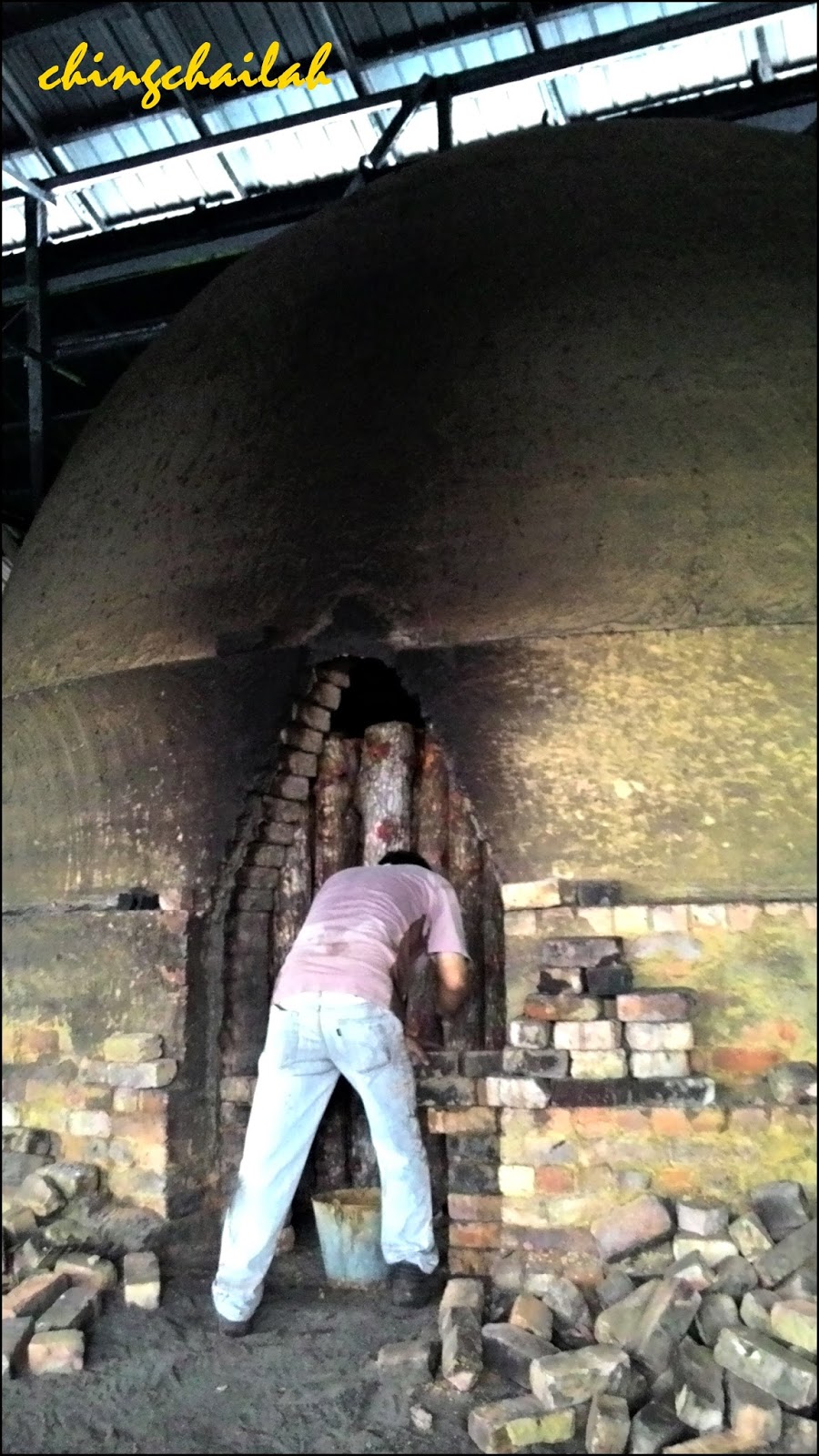
 The kiln can be filled with about 40 tons or 1,500 pieces of mangrove wood.
Photo #11
A worker is sealing up the big hole with bricks and mud to leave behind a smaller hole. 
Photo #12
A big fire is lit through the hole.
Photo #13
The fire is kept burning for 10 days to reach a temperature of 85 deg. C.
Photo #14
 The fire is not to burn the wood but to extract the 80 % of water found in the mangrove wood.
Photo #15
After the 10 days of big fire, the wood is left to steam for 14 days to further extract the remaining water content.
Photo #16
 Mud is used to hold the bricks together.
Photo #17
 Mud used as a sealing paste.
Photo #18
Water content is released as steam through the holes and collected in these blue containers and processed as by-products (in the next post, part 2).
 Photo #19
After the 14 days of steaming, the kiln is closed up and the charcoal is left to cool for 8 days, after which they will be taken out from the kiln to be packed for distribution.


 As charcoal to embers and as wood to fire,
so is a quarrelsome person for kindling strife.
(Proverbs 26:21, New International Version-NIV)
Related Posts Plugin for WordPress, Blogger...